
The Whirling Dervishes of Syria: Mawlawi tradition and Noureddine Khourchid in Wrocław
The Whirling Dervishes of Syria present the Mawlawi tradition, in which singing and turning dance form a spiritual whole. The Ethno Jazz Festival announcement at the White Stork Synagogue names Qur’anic singer Noureddine Khourchid as a guest.
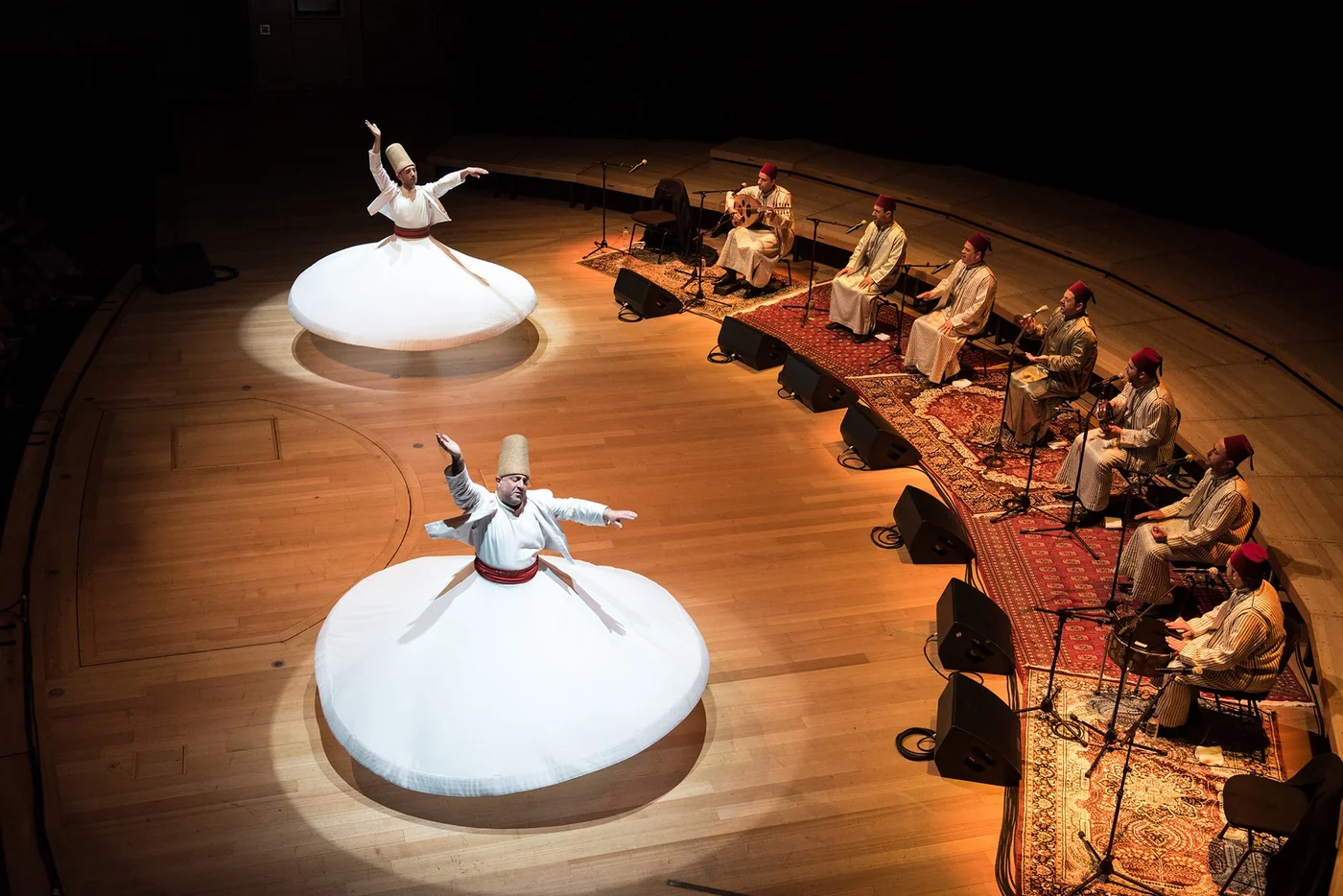
Ethno Jazz Festival is honoured to invite you to an extraordinary mystical spectacle: a performance by Syria’s Whirling Dervishes of the Mawlawi brotherhood, with a guest appearance by the outstanding Quranic singer Noureddine Khourchid.
The only Polish performance takes place on 24 November at the White Stork Synagogue, a central venue in Wrocław’s Four Denominations District of Mutual Respect.
Many mystical accounts of divine origins are closely connected with music. One tells of the soul, heavenly by its nature, refusing to take form until it was finally seduced by an angelic voice chosen by God. In Islam, religious songs are described by the general term inshad, referring to desire, striving towards a goal and seeking.
From a poetic perspective, the inshad repertoire includes songs praising God and prayers. It praises the Prophet, tells the story of his birth and ascension, and speaks of his heroic deeds and miracles. A significant proportion of Sufi poems also concerns divine love and ecstasy. The lyrics of these songs compile passages from poems centred on a single theme but drawn from different sources and periods in history.
Sama, a spiritual concert, and the trance dance Hadra, meaning divine presence, directly express many mystical paths to God. The fundamental aim is to draw closer to God by purifying the soul and practising dhikr, or remembrance. The Sufi sama practice may be purely vocal or accompanied by instruments, depending on the order and its rules. The instruments used were considered part of the ritual, so they are played not for pleasure but with the explicit purpose of praising the Creator.
Alongside the sung repertoire, the inshad tradition has also developed in the Muslim Arab world. It is sustained by professional hymn singers, or cantors, who may belong to Sufi orders, although this is not always the case. They are invited to lead religious ceremonies, especially during Mawlid, the anniversary of the Prophet's birth, and on other holy days.
The ensemble presented here, consisting of nine munhid, or cantors, and two dancers, is known for its professional approach and fluid performances. It has made guest appearances around the world. Dancers from the Mawlawi brotherhood perform with the ensemble.
The Mawlawi brotherhood's founder is considered to be Jalaluddin Rumi, a Sufi mystic and poet called Mevlana by his disciples, meaning “Our Master”. The common name for the Mevlevis, Whirling Dervishes, comes from their distinctive way of expressing reverence for God.
They pray to God in an intriguing way: through dance. A characteristic feature of this order is meditation in motion, through a series of dance figures, the most spectacular being the dancers spinning around their own axes. Hence the name: whirling dervishes. This spinning is intended to imitate the movement of celestial bodies, which, according to Mevlevi belief, intensifies love for God within the human soul. During the dance, the dervishes almost lose themselves in the experience, feeling it profoundly. Through it, they express their unity with God. The dance aims to achieve a spiritual trance.
Noureddine Khourshid was born in Damascus in 1966. By the age of five, he was regularly accompanying his father to weekly Muslim religious ceremonies. He studied the Quran and religion as required, also receiving training in religious singing, before deciding to devote himself to religious studies. His talent and vocal abilities soon attracted attention. In 1987, he founded a group specialising in religious songs and songs in praise of the Prophet.
The Wrocław performance will feature the following line-up:
Noureddin KHOURCHID: Lead Voice Abdulrahman MODAWAR: choirs & Riqq Mohamad KAHIL: choirs & Duff Mhd Ghassan ALRAWAS: choirs Adel HALIMA: choirs Walid ALHAMAD: choirs & tombak Basem KADMANI: choirs & Ud Hatem ALJAMAL: whirling dervish Mahmoud ALTAIER: whirling dervish
Event details
THE WHIRLING DERVISHES OF SYRIA
24 November 2015
19.00
White Stork Synagogue
Wrocław